
How one street vendor co-op could be the blueprint for creating safer vending experiences
By Miranda Morgan
Southern California is rich with night life: concerts, sporting events, raves and more. Where there are people, there tends to be appetites. Big appetites.
To fuel the hungry night-owls, it is not uncommon to spot street vendors on nearly every corner -- bacon-wrapped hot dogs, churros, tacos, loaded fries - the streets of California have it all.
While these vendors are (mostly) beloved by the residents of Southern California, they do not always garner the same appreciation from city and county officials.
In the Inland Empire, in that very lot in San Bernardino, one group of vendors have gotten creative with their operation. Together they have created the La Quinta Food Market – a vendor co-op started by and for vendors. With their creativity, they now have a safe place to vend -- free of harassment from city officials.
La Quinta Food Market is currently kept alive by three consistent vendors: Jenny Ruiz, Sylvia Corona and Veronica Jimenez.
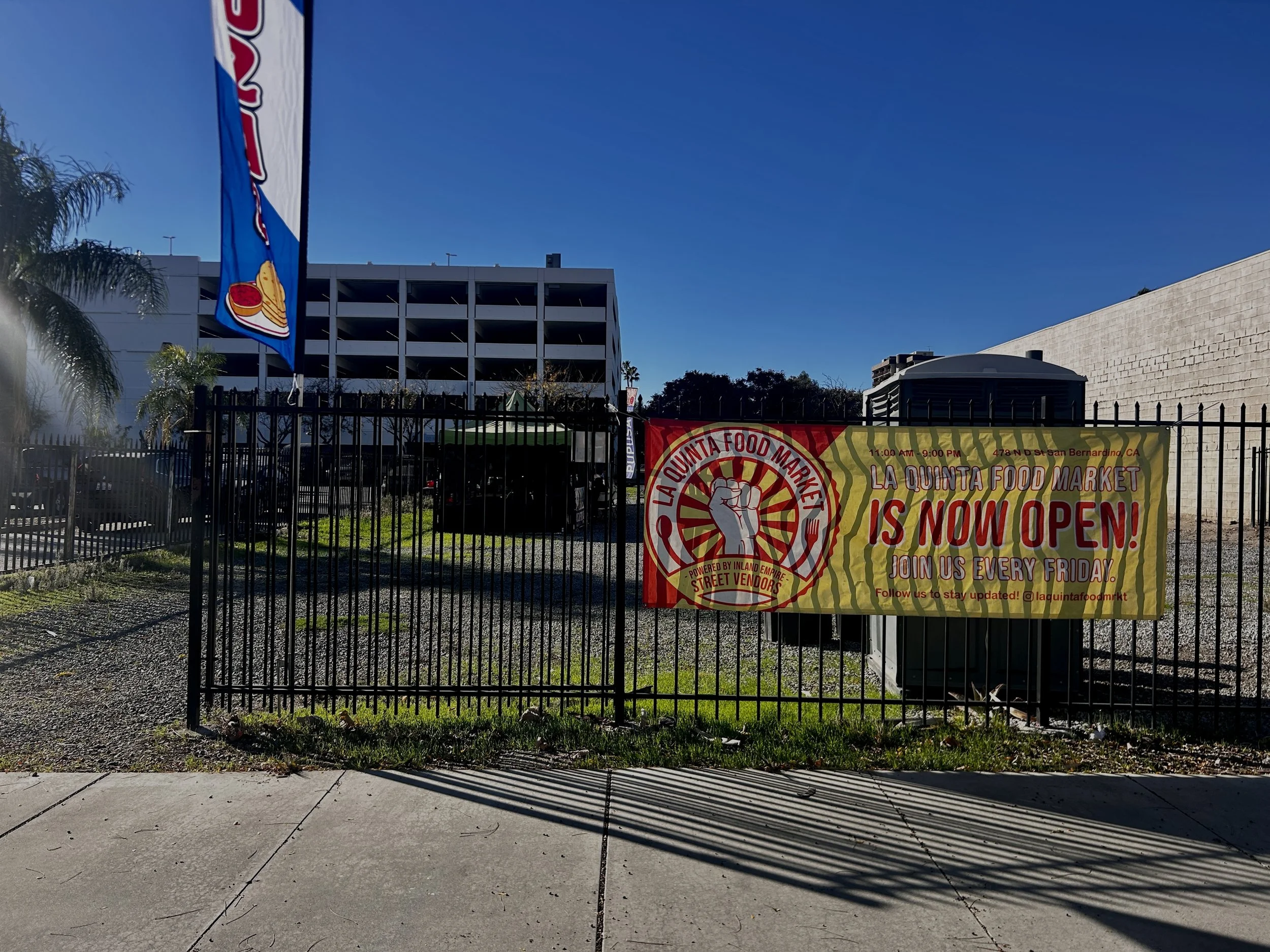
Photo by Miranda Morgan: The entrance to La Quinta Food Market.
Sylvia Corona
Before the COVID-19 pandemic, Sylvia Corona, a mother of six, made her livelihood by accompanying her husband to work. His job in construction required them to travel to Los Angeles, gone from 4 a.m. until 10 p.m. daily – precious time that she would never gain back with her young children.
“My older daughter had to be the babysitter. It was a lot of work on her, you know,” Corona recalled with tears in her eyes. “I was asking God for something.”
Following the shutdown of much construction work during COVID-19, Corona’s husband was unable to work as normal. While many would have considered this to be something awful, her family viewed it as the miracle from God they had hoped for.
She began vending – a new career that would allow her family to finally be united.
Following a short period of vending at a local church, another local vendor asked her to instead join him on the corner of Adams and State Street in the neighborhood of Muscoy. Eventually, she joined him. Business boomed. The miracle she had prayed for was becoming better everyday.
However, the risk of vending at Adams and State Street now outweighs the reward.
At the corner, a few vendors, such as Corona, found success in selling churros, pupusas and various other hispanic foods. However, following the closure of the Mount Vernon Swapmeet in Oct. 2021, up to one hundred vendors took to the very street that Corona's corner was on.
Some had permits while others did not. Some even sold alcohol – which is illegal regardless of permitting. Vendors spilled over the curbs and into the road.
“It became too much traffic, everybody setting up in the streets and on the sidewalks, leaving trash all over,” Corona described.
Suddenly, the successful little corner became an entire block of vendors. With more business came more competition. The increase in competition brought along unwanted attention from the city.
Efforts by the Inland Coalition for Immigrant Justice (IC4IJ) – a local coalition focused on providing aid, advice and solidarity to immigrants in Southern California – focused on reducing trash in the area and preventing city involvement. Efforts that unfortunately seemed to fall on deaf ears.
“A lot of vendors didn’t care, they just wanted to sell and make money,” Corona stated. “A lot of vendors would set up and not even move. They didn’t want to lose their spots because it was so crowded. They would be there twenty-four-seven.”
Inevitably, the police and city officials began getting involved. First, were the citations and warnings. Then, came the tickets and fines. Finally, seizures of equipment and raids of the block became common.
Folks such as Corona had no choice but to leave the area where she once made her livelihood, and her miracle dissipated.
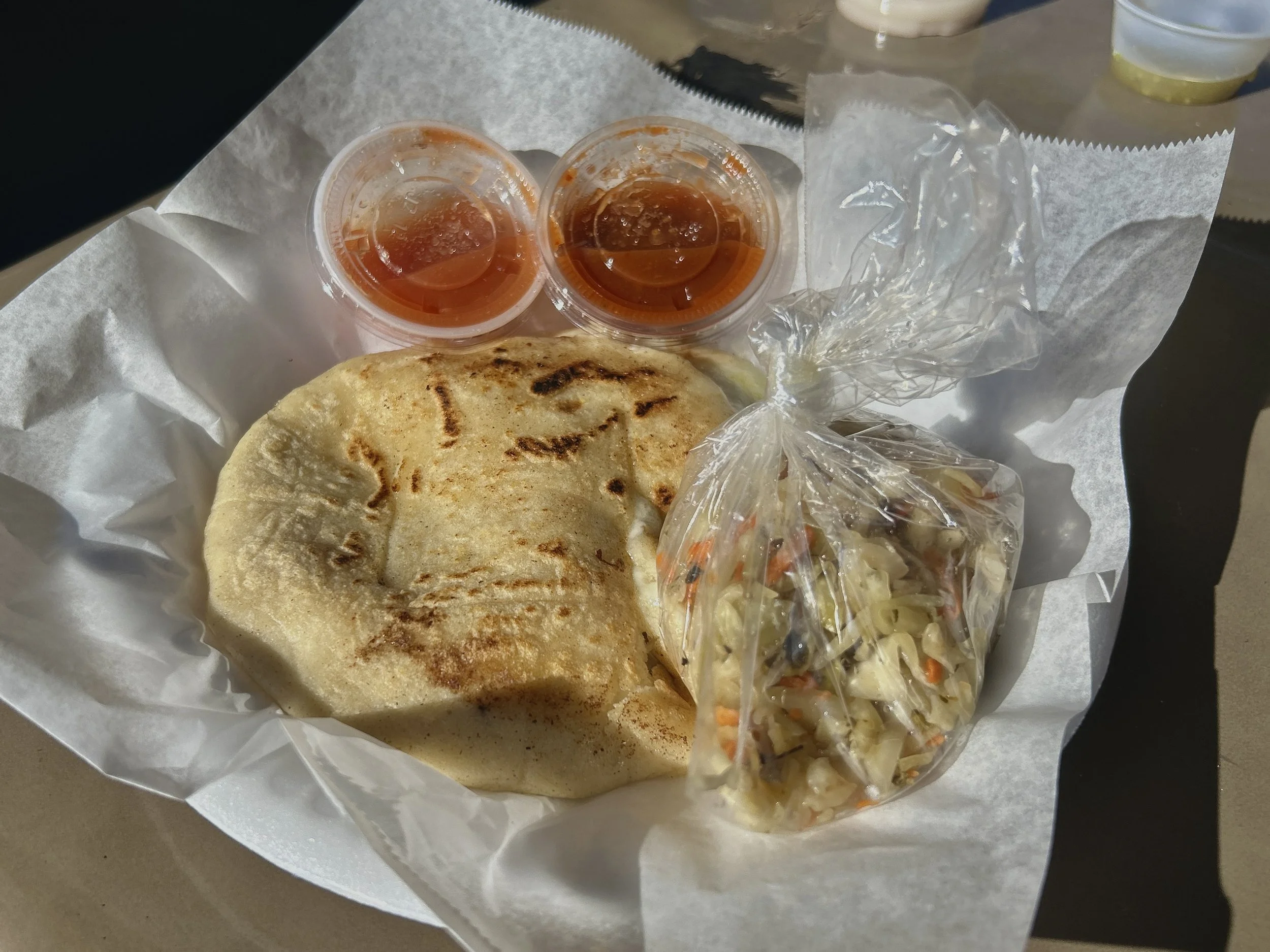
Photo by Miranda Morgan: A pupusa from Corona’s stand, Pupusas La Familia
Jenny Ruiz
Jenny Ruiz, one of the vendors who took to the same street as Corona, faced the consequences firsthand. She described her experience during one of the raids, where she found herself and her family surrounded by patrol cars, fined and humiliated.
“My children were confused by all the patrol cars,” Ruiz described. “They took photographs of me with the fine as if it were a trophy.”
That day, she only made enough to cover the fine – $250.
Unable to carry on vending, IC4IJ offered a helping hand. She was given courses with the entrepreneurs association and a $7,500 grant. While undeniably helpful, this did not solve Ruiz’s main problem: needing a permit.
Then came Melba Parada, a veteran business consultant.
Parada suggested Ruiz get a permit known as the Temporary Food Facility (TFF) permit. With it, vendors are able to set up shop at fairs, festivals, private events and farmer’s markets.
“This permit has existed for many years, but it had never reached a community like mine – the Latino community, people who don’t speak English, people who don’t know how to use a computer. Nobody was telling them anything.”
In a community vendor chat, Ruiz spread the word.
Taking her knowledge even further, she has created a non-profit organization called United Street Vendors of the Inland Empire, “where the main goal is to help street vendors with education, permits, and their entrepreneurship.”
“We started helping twenty vendors process permits,” Ruiz said. “From those twenty, it grew to hundreds. Now, we have a network of about 200 vendors, and I believe 90% of them have permits.”
The permits themselves, though, come with limits. TFF permits require renewal every 90 days. Within the 90-day validity, vendors are only granted a certain number of days that they can operate. Their set-ups must also go through inspections by four different entities: the fire department, health department, city and county officials.
The reward of these permits outweigh the risk of street vending to Ruiz. Unfortunately, she finds that not all vendors feel the same. Many are intimidated by the rules and regulations that come with permitting, and prefer the freedom of operating independently. Regardless, she continues to try to change the minds of as many vendors as possible.
“The key is persistence,” Ruiz stated.
Armed with permits and fellow vendors, including Corona, Ruiz created the La Quinta Food Market in March of 2024.
“Jenny’s dream was to open a market with vendors because back then, organizers would take advantage of vendors, ‘Either pay what I ask or leave.’,” Corona stated. “She wanted to open a market where we can be fair with the vendors and just treat everyone the same. That was her dream.”
Ruiz helped all the vendors gain permits if they did not already have them, charged them low space rates and gave them a safe place to operate. In return, business boomed. 15 vendors operated in the lot from 11 a.m. to 9:30 p.m. every Friday. Customers flooded in. Specialty events were held often. Ruiz found herself on podcasts. Youtubers flocked to the market to create content.
Vendors like Corona were finally able to get back to supporting her family, all without worrying about harassment from the city. Her prayer had been answered once again. Profits were good, and they were always for the vendor to keep. Finally, her dream had been realized.

Photo by Miranda Morgan: An agua de horchata from Jimenez’s stand.
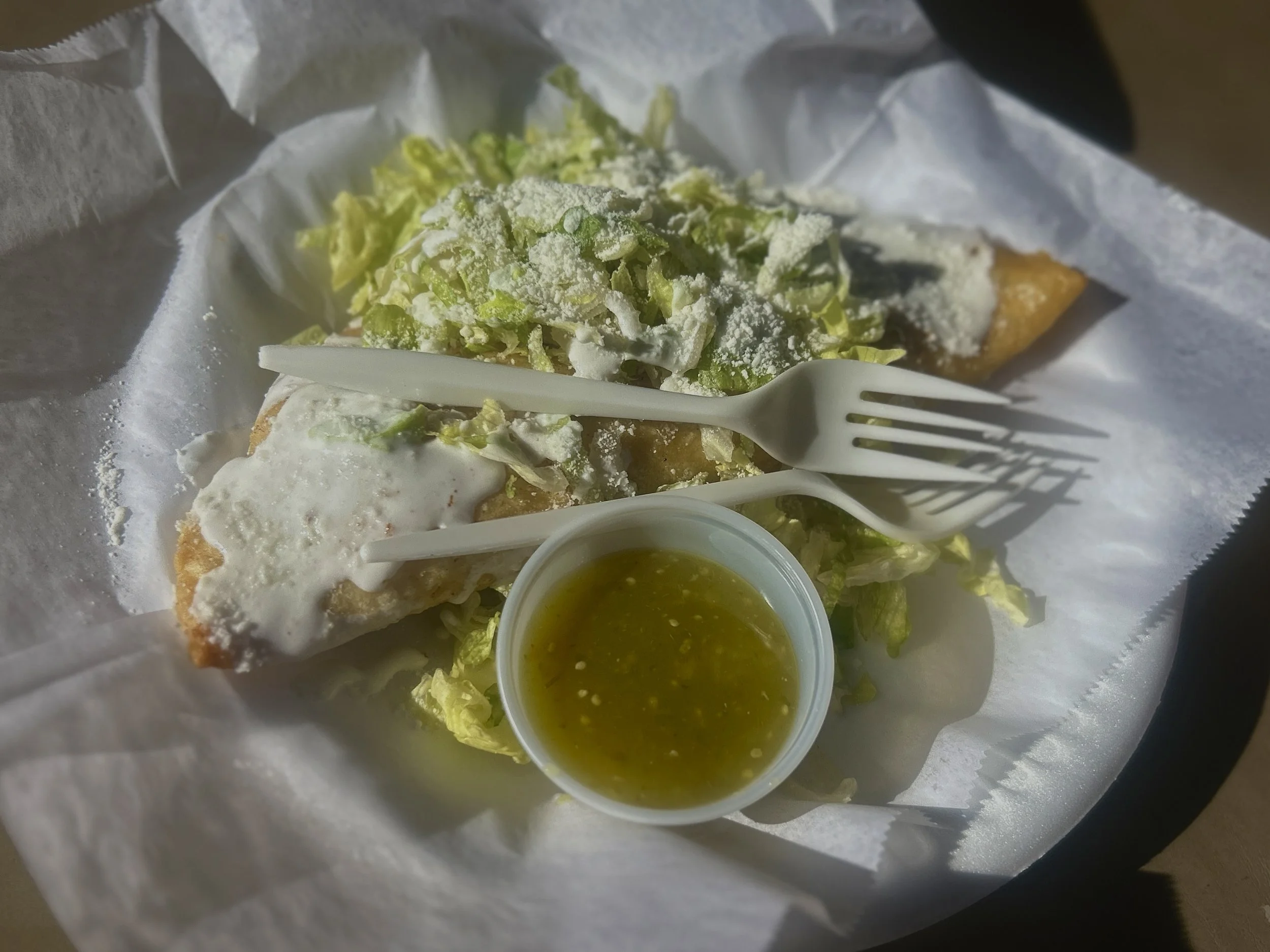
Photo by Miranda Morgan: A quesadilla from Jenny Ruz’s stand.
However, the market has found its once booming success dwindling. Competition from neighboring markets has taken more than customers – it has taken vendors too. Ruiz, Corona and Jimenez are the few consistent vendors that remain. New vendors will set up once or twice, but are swayed away by the lack of customers. Customers are swayed away by the lack of variety.
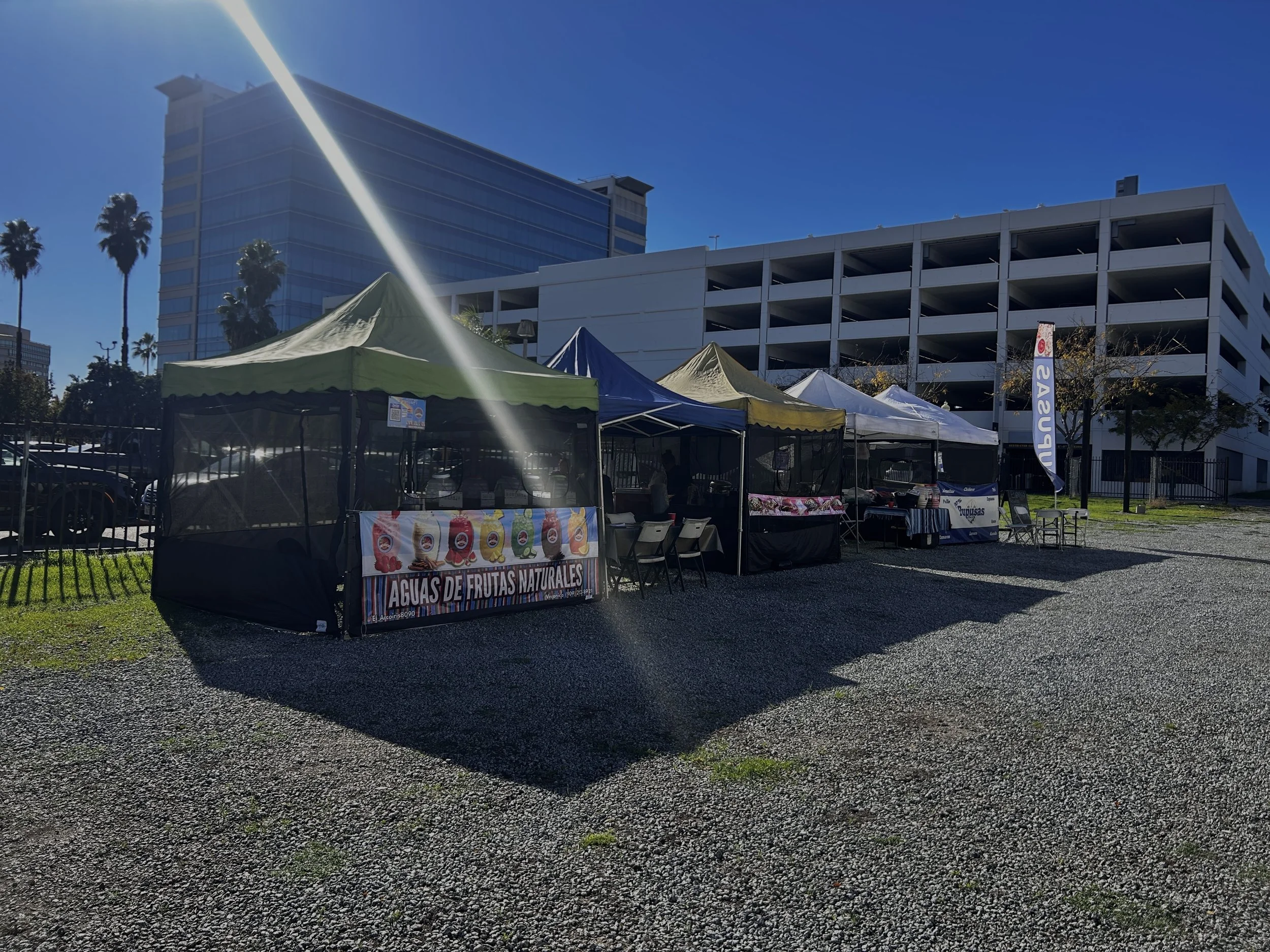
Photo by Miranda Morgan: The three consistent remaining vendor stands. From left to right: Aguas Naturales by Veronica Jimenez, La Tia Jenny Mexican Kitchen by Jenny Ruiz and Pupusas La Familia by Sylvia Corona.
Due to lack of foot traffic, the operating hours have been cut in half.
Additionally, the neighboring market has forbidden their vendors from participating in more than one market. They do so by telling their vendors that the permits they have do not allow vendors to be in two markets on the same day. However, this is only true for markets that occur in the same time frame. Regardless, scared to lose their spots at the market with the most foot traffic, they oblige. The other market has an estimated 50-60 vendors.
The cost to rent the lot La Quinta Food Market resides in is high. Determined to keep prices low for her vendors, though, Ruiz still only charges the other two $35 per day. Other markets charge upwards of $100 per day. The permits themselves also cost a whopping $1,000. At the current rate, operation is not maintainable financially.
The dream and determination to keep La Quinta going is still alive in Ruiz’s heart. The market itself will be undergoing a brief pause in January so that they can recuperate from the competition. They are hoping to eventually operate Friday to Sunday, somewhere with less competition. If they can find a location that fits this hope, they have a fighting chance.
“This project is very good. We’re not going to leave it like this,” Ruiz stated. “This can happen in any business, and we’re going to restructure and make it bigger so that we don’t have competition problems. It’s something we’ll need to learn.”
Ruiz’s confidence is contagious. From inside their pupusa stand, Corona’s husband chimed in to describe Ruiz as a strong woman who just refuses to quit.
“Una mujer con cajones.”
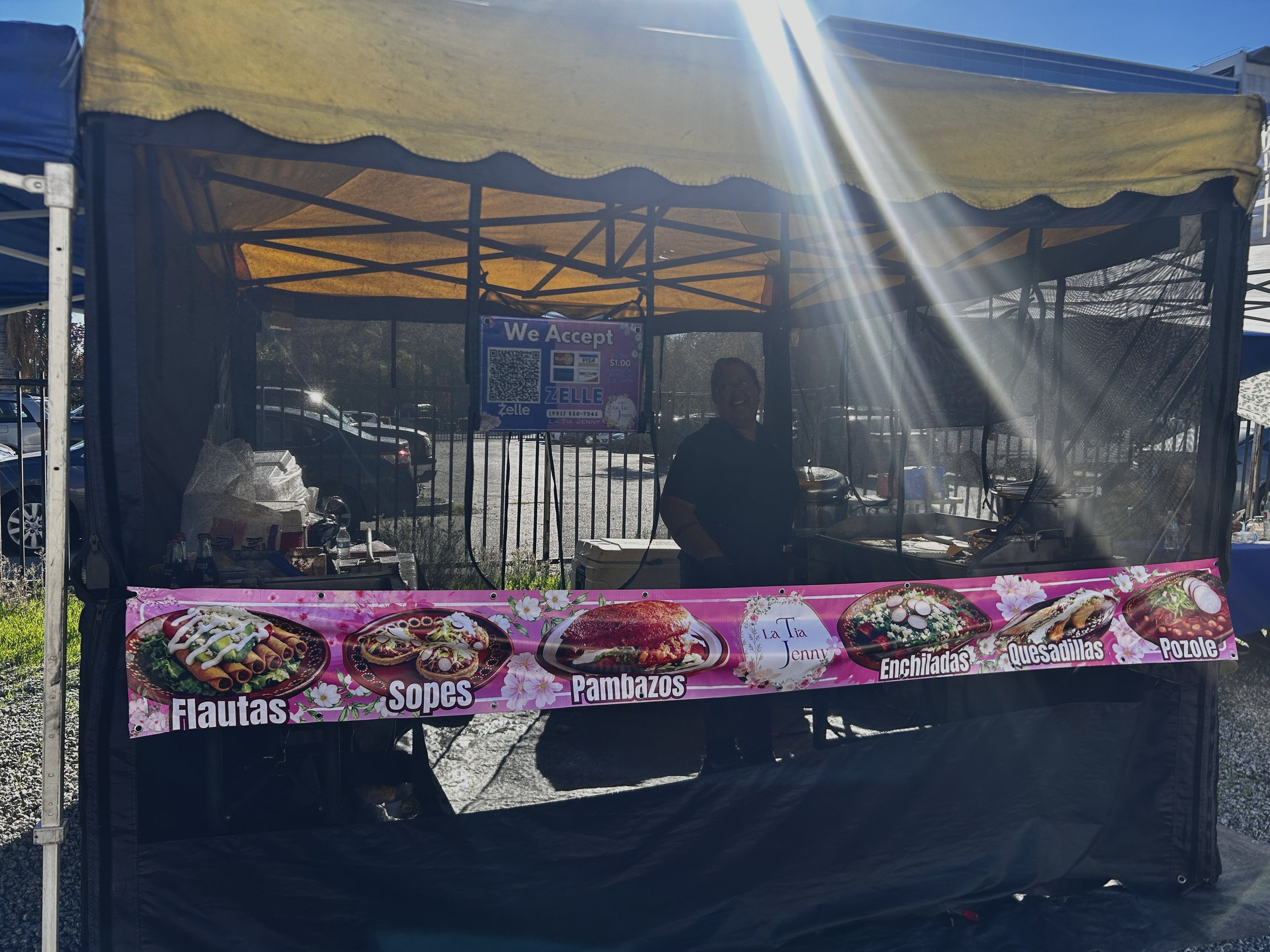
Photo by Miranda Morgan: Jenny Ruiz smiling from inside her vendor stand.